Encyclopedia: D
1,066 entries under D · page 7 of 11: Diodotus II – Doberan Abbey
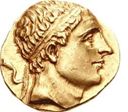 Diodotus IIPersonDiodotus II was the second king of the Greco-Bactrian Kingdom, son and successor of Diodotus I, ruling in the later 3rd century BCE.
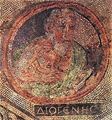 Diogenes the CynicPersonDiogenes the Cynic (c. 412–323 BCE) was a Greek philosopher born in Sinope on the Black Sea, and the best-known figure of the Cynic school.
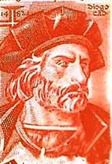 Diogo CãoPersonDiogo Cão was a Portuguese navigator who explored the coast of west-central Africa in the 1480s.
 Diogo de AzambujaPersonDiogo de Azambuja was a Portuguese captain and nobleman sent by King John II to the Gold Coast.
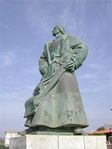 Diogo GomesPersonDiogo Gomes was a Portuguese navigator and explorer in the service of Prince Henry the Navigator.
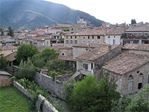 DioisPlaceThe Diois is a mountainous district in the Drôme department of south-eastern France, around the town of Die in the Drôme valley.
 DiomedesPersonDiomedes was a Greek hero of the Trojan War, king of Argos and one of the bravest fighters of the Iliad.
- DioneReligion / ideaDione was a Greek goddess worshipped with Zeus at the oracle of Dodona in Epirus, where she was his consort.
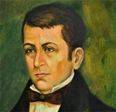 Dionisio de HerreraPersonDionisio de Herrera was a Honduran liberal lawyer and politician who became the first head of state of Honduras within the Federal Republic of Central America, serving…
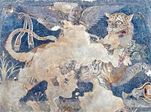 DionysiaEventThe Dionysia were Athenian festivals of the god Dionysus, the greatest being the City Dionysia held each spring.
 Dionysiou MonasteryWork / monumentDionysiou Monastery is an Eastern Orthodox monastery on Mount Athos in Greece, built on a rock above the sea on the peninsula's south-west coast.
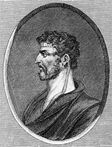 Dionysius I of SyracusePersonDionysius I was tyrant of Syracuse from 405 to 367 BCE and the most powerful Greek ruler in the west of his time.
- Dionysius II of SyracusePersonDionysius II of Syracuse, called the Younger, succeeded his father Dionysius I as tyrant of Syracuse in 367 BCE.
- Dionysius of PhocaeaPersonDionysius of Phocaea was a Greek naval commander during the Ionian Revolt against Persia.
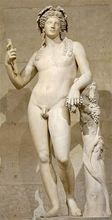 DionysusReligion / ideaDionysus was the Greek god of wine, vegetation, ecstasy and theatre, called Bacchus by the Romans.
- DiophantesPersonDiophantes, son of Asclepiodorus, was a general from Sinope in the service of Mithridates VI of Pontus.
- Diophantus (general)PersonDiophantus, son of Asclepiodorus, was a general from Sinope in the service of Mithridates VI of Pontus in the late 2nd century BCE.
- Dioscorus I of AlexandriaPersonDioscorus I was Patriarch of Alexandria from 444 to 451.
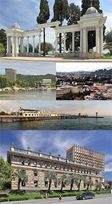 DioscuriasPlaceDioscurias was an ancient Greek colony on the eastern shore of the Black Sea, founded by settlers from Miletus in the 6th century BCE on the site of modern Sukhumi in…
- DipavamsaWork / monumentThe Dipavamsa, the "Chronicle of the Island", is the oldest surviving historical chronicle of Sri Lanka, written in Pali probably in the 4th century CE.
 Dipayal SilgadhiPlaceDipayal Silgadhi is a town in Doti district in far-western Nepal, on the Seti River.
 Dipendra of NepalPersonDipendra (1971–2001) was the crown prince of Nepal, the eldest son of King Birendra.
 Diploma AndreanumWork / monumentThe Diploma Andreanum was a charter issued by King Andrew II of Hungary in 1224 granting collective privileges to the German 'guests', the Transylvanian Saxons, settled…
- Diploma OttonianumWork / monumentThe Diploma Ottonianum was a charter issued on 13 February 962 by the newly crowned emperor Otto I to Pope John XII.
- Diplomacy and marriage alliancesHistorical factorDiplomacy and marriage alliances describes the use of treaties, gifts and dynastic marriages to win allies, legitimise rule and expand influence without war.
- Diplomatic marriageReligion / ideaDiplomatic marriage is the practice of arranging royal marriages to seal alliances between states.
 DiponegoroPersonDiponegoro was a Javanese prince of the Yogyakarta sultanate who led the Java War against Dutch rule from 1825 to 1830.
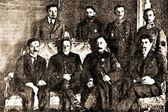 Directorate of UkraineInstitutionThe Directorate of Ukraine was the collective revolutionary government of the Ukrainian People's Republic, formed in November 1918 to overthrow Hetman Pavlo…
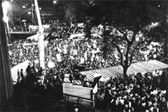 Diretas JáEventDiretas Já, 'Direct elections now', was a mass movement in Brazil in 1983–1984 demanding direct elections for president under the military dictatorship.
- Diretório dos ÍndiosWork / monumentThe Diretório dos Índios was a Portuguese law of 1757, drawn up by Governor Francisco Xavier de Mendonça Furtado and extended to all Brazil in 1758, that ended…
- DirhamTermThe dirham was the silver coin of the Islamic world.
 DiriyahPlaceDiriyah is a town in Wadi Hanifa on the north-western edge of Riyadh, Saudi Arabia.
- Dirk I, Count of HollandPersonDirk I (died c. 939) is regarded as the first Count of Holland.
- Dirk III, Count of HollandPersonDirk III, Count of Holland, ruled the West Frisian county that later became Holland from 993.
 Dirty WarEventThe Dirty War was the campaign of state terror waged by Argentina's military dictatorship between 1976 and 1983 against left-wing guerrillas, activists, students and…
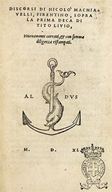 Discourses on LivyWork / monumentThe Discourses on Livy are a work of political theory by Niccolò Machiavelli, written around 1517 and published in 1531.
 Disentis AbbeyInstitutionDisentis Abbey is a Benedictine monastery in the upper Rhine valley of Graubünden, Switzerland, founded in the early 8th century.
 Dispositio AchilleaWork / monumentThe Dispositio Achillea was the house law issued in 1473 by Albert Achilles, Elector of Brandenburg, to regulate the Hohenzollern succession.
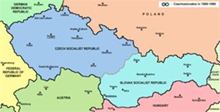 Dissolution of CzechoslovakiaEventThe dissolution of Czechoslovakia, known as the Velvet Divorce, divided the federation into the Czech Republic and Slovakia on 1 January 1993.
 Dissolution of the Holy Roman EmpireEventThe dissolution of the Holy Roman Empire took place in 1806, when Emperor Francis II abdicated the imperial title following Napoleon's victories and the creation of the…
- Dissolution of the Soviet UnionEventThe dissolution of the Soviet Union was the breakup of the USSR into fifteen independent states in 1991.
- Dit of PéronneTreaty · Peace · 1256The Dit of Péronne was the arbitration award given by King Louis IX of France at Péronne in September 1256 to end the War of the Flemish Succession.
- DiuPlaceDiu is a town and island off the southern coast of the Saurashtra peninsula in Gujarat, India.
- DiumaPersonDiuma was an Irish priest, one of four sent from Northumbria with Peada in 653 to preach to the Middle Angles.
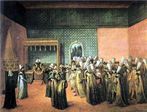 DivanInstitutionThe Divan was the imperial council of the Ottoman Empire, chaired by the grand vizier.
 DivashtichPersonDivashtich was the ruler of Panjikent in Sogdiana who in the early 720s claimed the titles king of Sogdiana and lord of Samarkand.
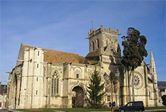 Dives-sur-MerPlaceDives-sur-Mer is a small town in the Calvados department of Normandy, at the mouth of the Dives.
 Diviciacus (Aedui)PersonDiviciacus was a druid and leading noble of the Aedui of central Gaul and the only druid known by name from antiquity.
- Diviciacus (Suessiones)PersonDiviciacus was a king of the Suessiones of northern Gaul whom Julius Caesar was told had, within living memory, been the most powerful ruler in Gaul.
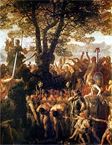 DivicoPersonDivico was a leader of the Tigurini, a Helvetian people, who defeated a Roman army under Lucius Cassius Longinus near Agen in 107 BCE during the wars of the Cimbri.
- Divided succession and partible inheritanceHistorical factorDivided succession and partible inheritance describes the practice of dividing a realm among a ruler's heirs rather than passing it intact to one successor.
 Divine Bell of King SeongdeokWork / monumentThe Divine Bell of King Seongdeok is a large bronze bell of Silla, begun by King Gyeongdeok in memory of his father Seongdeok and completed in 771 under King Hyegong.
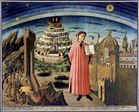 Divine ComedyWork / monumentThe Divine Comedy is a long narrative poem by Dante Alighieri, written in the Florentine vernacular from about 1308 until his death in 1321.
- Divine kingshipReligion / ideaDivine kingship is the idea that a ruler is a god or possesses divine status.
- Division of LeipzigEventThe Division of Leipzig of 1485 split the lands of the house of Wettin between the brothers Ernest and Albert.
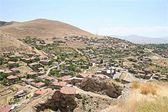 DivriğiPlaceDivriği is a town in Sivas province in eastern Turkey, near the upper Euphrates.
 Divriği Great Mosque and HospitalWork / monumentThe Divriği Great Mosque and Hospital is a joined mosque and hospital in eastern Anatolia, built in 1228–1229 by the Mengujekid ruler Ahmad Shah and his wife Turan Malik.
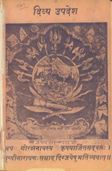 Divya UpadeshWork / monumentThe Divya Upadesh ("Divine Counsel") is the set of final political teachings of Prithvi Narayan Shah, the founder of unified Nepal, delivered to his courtiers at…
- DiwanInstitutionThe diwan was a register and administrative office in Islamic states.
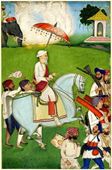 Diwan Dina NathPersonDiwan Dina Nath was a senior official of the Sikh Empire who managed its financial administration, succeeding Diwan Mohkam Chand.
- Diwan Lughat al-TurkWork / monumentThe Diwan Lughat al-Turk ('Compendium of the Languages of the Turks') is a dictionary of the Turkic languages written in Arabic by Mahmud al-Kashgari, a member of the…
- Diwan Mohkam ChandPersonDiwan Mohkam Chand was a leading official and military commander of the Sikh Empire under Ranjit Singh.
- DiwanusPersonDiwanus was a leader of the Bartians, one of the Old Prussian peoples, during the Great Prussian Uprising against the Teutonic Order that began in 1260.
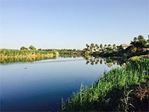 Diyala RiverPlaceThe Diyala is a river rising in the Zagros Mountains of western Iran, where it is called the Sirwan, and flowing through north-eastern Iraq to join the Tigris just…
- Diyar BakrPlaceDiyar Bakr was the medieval Arabic name for the northernmost province of the Jazira, the upper Tigris basin around Amid (modern Diyarbakır) and Mayyafariqin.
- Diyar MudarPlaceDiyar Mudar is the medieval Arabic name for the western part of the Jazira, the upper Mesopotamian region along the Euphrates and the Balikh, named after the Mudar…
- Diyar Rabi'aPlaceDiyar Rabi'a, 'the abode of the Rabi'a', was the eastern province of the Jazira in upper Mesopotamia in early Islamic times, around Mosul, Nisibis and the upper Tigris.
 DiyarbakirPlaceDiyarbakir, the ancient Amida, is a city in south-eastern Anatolia on the upper Tigris.
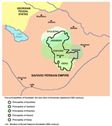 DizakPlaceDizak was one of the five Armenian melikdoms of Karabakh, known as the Khamsa, in the south of the region.
 DjanetPlaceDjanet is an oasis town in south-eastern Algeria, at the foot of the Tassili n'Ajjer plateau.
 DjedarsWork / monumentThe Djedars are thirteen stepped pyramid-shaped mausoleums on hilltops near Frenda and Tiaret in north-western Algeria, built between the 5th and 7th centuries.
- DjehutyhotepPersonDjehutyhotep was a nomarch of the Hare nome in Middle Egypt under the Twelfth Dynasty kings Amenemhat II, Senusret II and Senusret III.
 Djemal PashaPersonDjemal Pasha was an Ottoman officer and politician, one of the three Young Turk leaders who governed the empire during the First World War.
 DjennéPlaceDjenné is a city in the inland Niger Delta of present-day Mali, famous for its mud-brick Great Mosque.
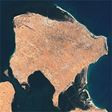 DjerbaPlaceDjerba is an island in the Gulf of Gabès off southern Tunisia, the largest in North Africa.
- Djibo BakaryPersonDjibo Bakary was a Nigerien trade unionist and politician who led the Sawaba party.
 Djinguereber MosqueWork / monumentThe Djinguereber Mosque is the great mosque of Timbuktu in Mali, a landmark of earthen Sudano-Sahelian architecture.
 DjoserPersonDjoser was a king of ancient Egypt's Third Dynasty who reigned in the 27th century BCE.
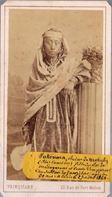 Djoumbe FatimaPersonDjoumbe Fatima was queen of Mohéli in the Comoros, succeeding her father Ramanetaka, a Merina prince, as a child in 1842.
- Djuanda DeclarationEventThe Djuanda Declaration was issued on 13 December 1957 by the Indonesian prime minister Djuanda Kartawidjaja.
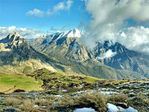 DjurdjuraPlaceThe Djurdjura is a mountain range of the Tell Atlas in northern Algeria, rising to 2,308 m at Lalla Khedidja and forming the backbone of Greater Kabylia.
- Dmitri ShostakovichPersonDmitri Shostakovich was a Russian composer, among the most important of the twentieth century, best known for his fifteen symphonies and fifteen string quartets.
 DmitrovPlaceDmitrov is a town in Moscow Oblast, Russia, about 65 kilometres north of Moscow.
- Dmitry Bobrok-VolynskyPersonDmitry Bobrok-Volynsky was a Russian commander of the 14th century, a nobleman from Volhynia who entered the service of Grand Prince Dmitry Donskoy of Moscow.
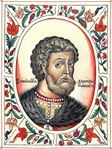 Dmitry DonskoyPersonDmitry Donskoy was Grand Prince of Moscow from 1359 and of Vladimir from 1362.
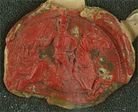 Dmitry KorybutPersonDmitry Korybut was a Lithuanian prince of the Gediminid dynasty, a son of Grand Duke Algirdas, who held Novgorod-Seversky in the late 14th century.
 Dmitry MilyutinPersonDmitry Milyutin was a Russian statesman who served as War Minister from 1861 to 1881.
- Dmitry of PereslavlPersonDmitry of Pereslavl (Dmitry Alexandrovich) was the second son of Alexander Nevsky, prince of Pereslavl-Zalessky and grand prince of Vladimir for most of the period from…
 Dmitry of SuzdalPersonDmitry of Suzdal, Dmitry Konstantinovich, was prince of Suzdal and Nizhny Novgorod and held the Golden Horde's patent as Grand Prince of Vladimir from 1360 to 1363.
 Dmitry of UglichPersonDmitry of Uglich was the youngest son of Ivan the Terrible.
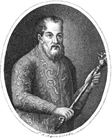 Dmitry PozharskyPersonPrince Dmitry Pozharsky was a Russian nobleman and commander.
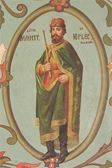 Dmitry ShemyakaPersonDmitry Yuryevich Shemyaka was a Russian prince of Galich, son of Yury of Zvenigorod, and a leading figure in the civil war over the throne of Moscow.
- Dmitry UlyanovPersonDmitry Ulyanov was a Bolshevik physician and the youngest brother of Vladimir Lenin.
 Dmytro VyshnevetskyPersonDmytro Vyshnevetsky, remembered in Ukrainian folk song as Baida, was a Ruthenian prince and Cossack leader.
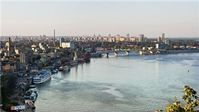 DnieperPlaceThe Dnieper is a major river of Eastern Europe, flowing through present-day Russia, Belarus and Ukraine to the Black Sea.
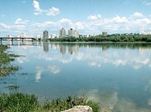 DniesterPlaceThe Dniester is a river of Eastern Europe, about 1,360 kilometres long, rising in the Carpathians of western Ukraine and flowing through Moldova to the Black Sea near…
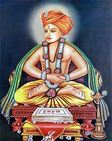 DnyaneshwarPersonDnyaneshwar was a Marathi poet-saint who in 1290 completed the Dnyaneshwari, a verse commentary on the Bhagavad Gita and one of the founding works of Marathi literature.
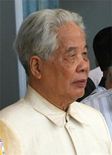 Do MuoiPersonDo Muoi was a Vietnamese communist leader who served as prime minister from 1988 to 1991 and as general secretary of the Communist Party from 1991 to 1997.
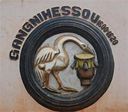 Do-AklinPersonDo-Aklin is remembered in the traditions of Dahomey as the leader of the royal family that migrated from Allada to the Abomey plateau around 1600, after a succession…
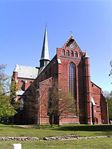 Doberan AbbeyWork / monumentDoberan Abbey was a Cistercian monastery near the Baltic coast of Mecklenburg, founded in 1171 by Pribislav, the first Christian prince of the Obotrites.