Culture · Europe
Thracians
At a glance
- ‘Thracians’ was the Greek name for some 200 tribes of south-eastern Europe who shared much of their culture but were rarely united in one state.
- Greek and Roman writers called them warlike barbarians while hiring them as mercenaries and noting their poetry and music; the fairness of these accounts is now questioned.
- Their tombs and gold and silver treasures, studied mainly in Bulgaria and Romania, give a fuller picture of a people gradually absorbed into Roman, Byzantine and Slavic societies.
Timeline
- 8th century BCEThe first Greek colonies are founded on the Thracian coasts
- 637 BCEThe Thracian Treres, with the Cimmerians and Lycians, capture Sardis, the Lydian capital, except its citadel
- 513 BCEDarius I of the Achaemenid Empire marches into Thrace and brings its tribes under Persian rule
- early 5th century BCETeres I founds the Odrysian Kingdom, the first lasting Thracian state
- 73–71 BCEThe Thracian gladiator Spartacus leads a great slave uprising in southern Italy
- 46 CEThracia becomes a Roman province after the murder of King Rhoemetalces III
- 570 CEAntoninus Placentius records monks speaking Bessian at a monastery near Mount Sinai
- 1960s–1970sIntensive excavations in Bulgaria uncover many Thracian tombs and sanctuaries
Origins

“Thracians” is the name the ancient Greeks gave to many peoples of the eastern Balkans. It comes from the Greek Thrāix, and both it and the name of their land, Thrace, are exonyms, names given by outsiders; according to Stephanus of Byzantium the land was once called Perki and Aria. The first record of the name is in Homer’s Iliad, where Thracians from the land bounded by the Hellespont fight as allies of the Trojans; the Trojan War is believed to have taken place around the 12th century BCE. In Greek myth Thrax, the quintessential Thracian, was a son of the god Ares, who was regarded as Thrace’s patron.
Thracian origins are obscure, because the Thracians left no written records before they met the Greeks. It is generally proposed that they developed from a mixture of indigenous peoples and Indo-Europeans during the Proto-Indo-European expansion of the Bronze Age, and like other Indo-European-speaking groups of Europe they are believed to descend from Proto-Indo-Europeans and Early European Farmers. During the 5th and 4th millennia BCE the inhabitants of the eastern Balkans became organised into groups that the Greeks later called Thracians; Thracian culture emerged in the early Bronze Age and flourished in the 3rd and 2nd millennia BCE. Leo Klejn identifies the proto-Thracians with the multi-cordoned ware culture, pushed out of Ukraine by the advancing Srubnaya culture.
Accounts differ on how united they were. The Thracians spoke the now-extinct Thracian language and shared a common culture, but one view holds that they did not all speak the same language, the varied landscape preventing a single one from forming. They were split into many tribes, about 200 of which have been identified, living across most of the Balkans, from the Getae north of the Danube to Pannonia in the west, and in Bithynia and Mysia in Anatolia.
Society

Most Thracians lived in simple, open villages and were not city-builders: their only polis was Seuthopolis, the capital founded by Seuthes III around 330 BCE. They were divided into a great number of tribes, and ancient historians held that only this constant political fragmentation stopped them overrunning the lands of the north-eastern Mediterranean. Herodotus called them the second most numerous people he knew of, after the Indians, and potentially the most powerful but for their lack of unity.
Several powerful states did form. The Odrysian Kingdom, founded by Teres I in the early 5th century BCE, was a union of more than 40 Thracian tribes and 22 kingdoms, centred on present-day Bulgaria. In the 1st century BCE the powerful Dacian state of Burebista emerged. Greek writers describe Thracian men as polygamous, and in Menander a speaker says that no Thracian takes fewer than ten, eleven or twelve wives, while Herodotus claims that unmarried Thracian women were free to choose their partners. Some peoples of Moesia were vegetarian, living on honey, milk and cheese.
War shaped Thracian society. They were known as skilled horsemen and as peltasts, lightly armed skirmishers with javelins, and their soldiers were valued as mercenaries, particularly by the Macedonians and Romans. Noblemen were buried with their horses and chariots so that these could serve them again in the afterlife. Thracians were also among the main victims of Greek slave raids: of 32 slaves of known origin confiscated from the men who mutilated the Hermai in Athens, 13 came from Thrace, and in Aristophanes’ comedies a slave woman is simply called Thratta, “Thracian woman”.
Beliefs & Worldview
The Thracians followed a polytheistic religion with some monotheistic elements. A cult found in Thrace, Moesia, Phrygia and the lands of the Dacians and Getae honoured the “Thracian horseman”, also known as Sabazios or the Thracian Heros, by a Thracian name Heros Karabazmos, a god of the underworld usually shown on funeral monuments as a rider slaying a beast with a spear. The Getae and Dacians may have had a monotheistic religion centred on the god Zalmoxis, though this is heavily debated. The Balkan thunder god Perkon belonged to the Thracian pantheon, although the cults of Orpheus and Zalmoxis likely overshadowed him.
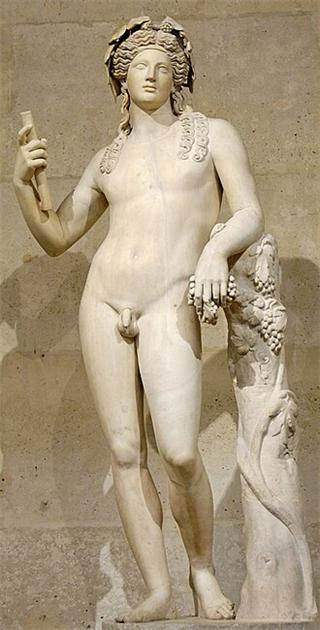
The Thracians are considered the first to worship the god of wine, called Dionysus in Greek and Zagreus in Thracian, whose cult later reached Greece, and some regard Thrace as the motherland of wine culture. In myth Orpheus, chief among poets and musicians, was a king of the Thracian Cicones. In classical times celibate ascetics called ctistae lived in Thrace as philosophers, priests and prophets, held in honour and dedicated to the gods.
Other customs are known from outside accounts and archaeology. Tattooing was common among both men and women. The French historian Victor Duruy wrote that the Thracians practised human sacrifice, which archaeological evidence has confirmed. Christianity came late: towards the end of the 4th century CE Nicetas, Bishop of Remesiana, preached to the Bessi, and Christianity eventually replaced the worship of Dionysus and the other Thracian gods.
Arts & Knowledge
Thracian craftsmanship is best known from the elaborate gold and silver treasures of the 5th and 4th centuries BCE, such as the Panagyurishte, Rogozen, Valchitran, Borovo and Lukovit treasures, which have been exhibited in museums around the world. Excavations in Bulgaria have uncovered tombs and sanctuaries such as the Tomb of Kazanlak in the Valley of the Thracian Rulers, the Getic burial complex and the Tomb of Sveshtari, and the sites of Tatul and Perperikon. Greek and Roman writers, who thought the Thracians unsophisticated, still noted the sophistication of their poetry and music.
Thracian writing is very scarce: only four inscriptions have been found. One, on a gold ring unearthed in the village of Ezerovo in Bulgaria, has eight lines written in the Greek script, but attempts to decipher it have been inconclusive.
Weapons show special skill. Well-preserved bronze fencing swords from as early as the 16th century BCE have been found across Bulgaria and suggest that duelling was common. The rhomphaia, a two-handed polearm with a long, slightly curved blade, was the deadliest Thracian weapon, especially effective against cavalry and war elephants, and the sica was a curved short sword. High-ranking soldiers of the archaic period wore helmets of boar tusks; later helmet styles were adapted to give riders better all-round vision and ease of movement, and Philip of Macedon adopted the Thracian cavalry’s wedge-shaped formation.
Contact & Exchange
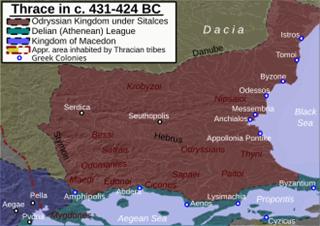
The Thracians lived among Greeks, Persians, Scythians and Celts. Greek colonies were founded along their coasts from the 8th century BCE, first on the Aegean, then on the Sea of Marmara and the Black Sea, and Thracians and Greeks lived side by side. In 637 BCE the Thracian Treres, allied with the Cimmerians and the Lycians, attacked Lydia and took its capital, Sardis, apart from its citadel, until Scythians under Madyes drove them out of Asia Minor.
From 513 BCE Darius I of the Achaemenid Empire marched through Thrace. Many tribes, including the Odrysae, submitted, and the Getae south of the Danube were defeated. Thrace became part of the Persian satrapy of Skudra, and Thracians served in the Persian army in the second invasion of Greece. Persian authority in central Thrace lasted until about 465 BCE, after which the Odrysian Kingdom, the Kingdom of Macedon and Athens filled the gap. The Odrysians were long allies of Athens and joined the Peloponnesian War on its side; in the 4th century BCE Philip II of Macedon conquered southern Thrace, and Thracian cavalry and javelin men later served Alexander the Great at Issus and Gaugamela.
Celts advanced into Thrace in 279 BCE and remained until the end of the 3rd century BCE; three Celtic tribes went on to found Galatia in Anatolia. After the Battle of Pydna in 168 BCE Rome took over the governance of Thrace, and the revolt of Andriscus in 149 BCE drew most of its support from Thrace. A Roman client kingdom under the Sapaei followed, until Thracia became a Roman province after King Rhoemetalces III was murdered in 46 CE. Earlier, the Thracian gladiator Spartacus had led a great slave rising in southern Italy in 73–71 BCE.
Legacy

Repeated invasions of the Balkans by Romans, Celts, Huns, Goths, Scythians, Sarmatians and Slavs, together with Hellenisation, Romanisation and later Slavicisation, reshaped the ethnicity, language and culture of Thrace. Writers still spoke of a separate Thracian nationality into the Early Middle Ages, and the last reported use of a Thracian language was by monks in the 6th century CE. Several Roman and Byzantine emperors were wholly or partly of Thracian descent, among them Maximinus Thrax, Galerius and Leo I the Thracian, and Constantine the Great was born to a Thracian father of the Moesi tribe.
Most likely the Thracians were assimilated into Roman and Byzantine society and became one of the ancestral groups of modern south-eastern Europeans. Those not yet assimilated were incorporated into the Slavic-speaking Bulgarian Empire; under Asparuh in 680 CE Thracians, Bulgars and Slavs united in the First Bulgarian Empire, and the three groups mingled to produce the Bulgarian people. Gottfried Schramm speculated that the Albanians descend from the Thracian Bessi, but there is no archaeological or linguistic support for this. Genetic studies suggest that about 55% of modern Bulgarians’ ancestry is of Paleo-Balkan and Mediterranean origin, attributed to Thracians, Anatolians and other peoples of the Balkans before the Slavs and Bulgars.
The study of the Thracians is called Thracology. Bulgaria and Romania have used archaeology to learn about them since the 19th and early 20th centuries, and intensive excavations in the 1960s and 1970s, mainly in southern Bulgaria, uncovered many tombs and sanctuaries. Since 2000 Georgi Kitov has made discoveries in the “Valley of the Thracian Kings” in central Bulgaria, including the residence of the Odrysian kings at Starosel, and a project begun in Bulgaria in 2016 brought together 72 scholars to study Thracian heritage.
The Thracians were Indo-European-speaking peoples of south-eastern Europe, centred on present-day Bulgaria, whom the Greeks named as one people though they lived in some 200 tribes. Famed as horsemen and peltasts, they made rich gold and silver work, worshipped the Thracian horseman and Dionysus, and formed states such as the Odrysian Kingdom. Under Persian, Macedonian and Roman rule they were gradually absorbed into the peoples of the Balkans.
References
- Kaul, F. (2011) The Gundestrup Cauldron: Thracian Art, Celtic Motifs. Études Celtiques 37 (1): 81–110.
- Tušlová, P., Weissová, B. and Bakardzhiev, S. (eds) (2022) The Yurta-Stroyno Archaeological Project: Studies on the Roman Rural Settlement in Thrace. Prague: Charles University, Faculty of Arts.