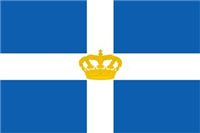
At a glance
- Created by Britain, France and Russia in 1832 with Otto of Bavaria as king, it was the first nation state carved from the Ottoman Empire.
- Pursuing the Great Idea of uniting all Greeks, it more than doubled its territory before defeat in Asia Minor in 1922.
- Abolished in 1924, restored in 1935, it lived through occupation, civil war and a military junta that ended the monarchy in 1973.
Rise & Fall
- 1833Otto of Bavaria lands at Nauplia as first King of Greece
- 1864Britain cedes the Ionian Islands as George I begins his reign
- 1912–13The Balkan Wars bring Thessaloniki, Macedonia, Epirus and Crete into Greece
- 1922Defeat in Asia Minor; Smyrna burns and over a million refugees flee
- 1924The monarchy is abolished; it is restored by plebiscite in 1935
- 1940Greece rejects Italy’s ultimatum and drives the invaders into Albania
- 1967The colonels’ coup; Constantine II goes into exile after a failed counter-coup
- 1973The junta abolishes the monarchy
Foundation
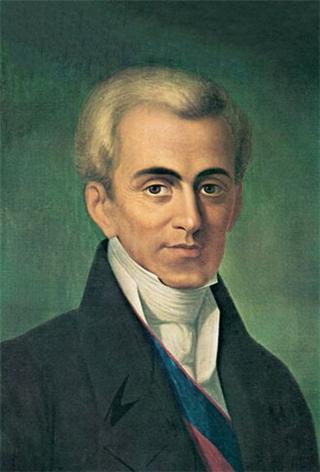
The Kingdom of Greece emerged from the Greek War of Independence, which began against the Ottoman Empire in 1821 and was decided by the intervention of Britain, France and Russia, whose fleets destroyed the Ottoman-Egyptian fleet at the Battle of Navarino in 1827. The London Protocol of 1830 recognised an independent Greek state, but its first governor, Ioannis Kapodistrias, was assassinated in 1831 and the country fell into civil strife. At the London Conference of 1832 the three protecting powers offered the throne to Otto, the sixteen-year-old second son of King Ludwig I of Bavaria, and the Treaty of Constantinople that year fixed the northern frontier on a line from the Gulf of Arta to the Gulf of Volos. The new kingdom comprised the Peloponnese, Central Greece and the Cyclades, with well under a million inhabitants, while most Greeks still lived under Ottoman rule. Otto landed at Nauplia in 1833 with a Bavarian regency and Bavarian troops, and in 1834 the capital was moved to Athens, then a small town below the Acropolis, which was rebuilt as a neoclassical capital. A revolt by the army and the people of Athens on 3 September 1843 forced Otto to accept a constitution, adopted in 1844.
Socioeconomy

The kingdom began as a poor, war-damaged agrarian country of peasants, shepherds and seafarers, and the distribution of former Ottoman lands to cultivators proceeded slowly. Exports of currants, olive oil, tobacco and later wine linked it to European markets, and the collapse of currant prices in the 1890s caused great distress. Shipowners from islands such as Syros, Hydra, Andros and Chios built one of the largest merchant fleets in the Mediterranean, and Piraeus grew into the country’s chief port and industrial centre. The state borrowed heavily abroad for railways, roads and the Corinth Canal, opened in 1893, and declared bankruptcy in 1893. Mass emigration followed, above all to the United States in the early twentieth century, and remittances became vital to the economy. The Orthodox Church, made autocephalous by the Greek state in 1833 and recognised by the Patriarchate of Constantinople in 1850, was a pillar of national identity. Society was transformed in the 1920s by the arrival of over a million refugees from Asia Minor and Eastern Thrace, who settled in new suburbs of Athens and Thessaloniki and on land in Macedonia distributed by agrarian reform. After the Second World War, American aid, tourism, shipping and rapid urbanisation produced high growth in the 1950s and 1960s, while hundreds of thousands emigrated to West Germany and Australia.
Military

Military affairs were bound up with the ‘Great Idea’ (Megali Idea), the aim of uniting all Greeks in one state. The army was small and often politicised, and it repeatedly intervened in politics, from the revolt of 1843 to the coups of the twentieth century. Rebellions in Ottoman Crete and elsewhere drew Greece into conflict, and the brief Greco-Turkish War of 1897 ended in humiliating defeat, an indemnity and international financial control. Reorganised after the military coup at Goudi in 1909, the army and navy performed well in the Balkan Wars of 1912–13: Greek forces entered Thessaloniki on 8 November 1912, took Ioannina in 1913, and defeated Bulgaria in the Second Balkan War, while the fleet commanded by Pavlos Kountouriotis won control of the Aegean. Greece entered the First World War on the Entente side in 1917 and fought on the Macedonian front. In 1919 its troops landed at Smyrna, and the Treaty of Sèvres of 1920 seemed to fulfil the Great Idea, but the advance into Anatolia was halted at the Sakarya River in 1921, and in August 1922 the Turkish nationalist army routed the Greek forces. In October 1940 Greece rejected an Italian ultimatum and drove the Italian invaders back into Albania, but the German invasion of April 1941 overran the mainland and, in May, Crete.
Governance & Law

Otto ruled at first as an absolute monarch through Bavarian officials, and after 1844 as a constitutional king who manipulated elections; he was deposed in 1862. The National Assembly then chose Prince William of Denmark, who reigned as George I from 1863 to 1913 under the constitution of 1864, which established universal male suffrage and a single-chamber parliament. Charilaos Trikoupis, prime minister several times between 1875 and 1895, secured the principle that the king must appoint a government with the confidence of parliament, and modernised the infrastructure. After the Goudi coup of 1909 Eleftherios Venizelos came from Crete to lead reforming governments that revised the constitution in 1911. The National Schism over entry into the First World War split the country between Venizelos and King Constantine I, with a rival government in Thessaloniki in 1916 and the king’s forced departure in 1917. After the disaster of 1922 a military revolution forced Constantine to abdicate, five leading politicians and a general were executed in the Trial of the Six, and in 1924 Greece became a republic. A plebiscite restored George II in 1935, but in 1936 he allowed Ioannis Metaxas to establish a dictatorship. After 1946 the restored monarchy ruled through conservative governments under Alexandros Papagos and Konstantinos Karamanlis, with left-wing parties restricted, until the crisis of 1965 between King Constantine II and George Papandreou.
Global & Regional Impact

The Kingdom of Greece was the first new nation state carved out of the Ottoman Empire, and its creation by the intervention and guarantee of the great powers set a pattern followed by Serbia, Romania and Bulgaria. Its pursuit of the Great Idea, and that of its Balkan neighbours, shaped the wars that ended Ottoman rule in Europe, and its territory grew from the narrow state of 1832 to include the Ionian Islands (1864), Thessaly and Arta (1881), Macedonia, Epirus, Crete and the eastern Aegean islands (1912–13), Western Thrace (1920) and the Dodecanese (1947). The defeat of 1922 and the exchange of populations agreed with Turkey at Lausanne in 1923, which brought over a million Orthodox Christians to Greece and sent some 400,000 Muslims to Turkey, ended some three thousand years of Greek life in Asia Minor and became a model, much debated since, for compulsory population transfers. The kingdom fostered a modern Greek culture, with the University of Athens founded in 1837, the long ‘language question’ between the learned katharevousa and spoken demotic Greek, and writers such as Kostis Palamas, Nikos Kazantzakis and the Nobel laureate George Seferis. Athens hosted the first modern Olympic Games in 1896. In the Cold War the Greek Civil War and the Truman Doctrine of 1947 made Greece an early front of American containment policy.
Decline & Fall

The monarchy ended twice. The first time, the defeat in Asia Minor in 1922 discredited the dynasty, and George II left the country in December 1923; the Second Hellenic Republic was proclaimed on 25 March 1924 and confirmed by plebiscite. A coup by General Georgios Kondylis and a dubious plebiscite restored the monarchy in 1935, but it was soon identified with the Metaxas dictatorship. During the Axis occupation of 1941–44, when famine killed tens of thousands in Athens and Piraeus and most of the Jews of Thessaloniki were deported to Auschwitz in 1943, the king and government were in exile, and the communist-led resistance of EAM-ELAS opposed their return. Fighting in Athens in December 1944 and the Civil War of 1946–49 ended in defeat for the communists, and a plebiscite in 1946 brought back George II, succeeded in 1947 by Paul and in 1964 by Constantine II. Constantine’s clash with George Papandreou in 1965 destabilised parliamentary politics, and on 21 April 1967 colonels led by Georgios Papadopoulos seized power. After his failed counter-coup in December 1967 Constantine went into exile. The junta abolished the monarchy on 1 June 1973, confirmed by a controlled referendum, and after the regime collapsed over Cyprus in 1974 a free referendum in December voted by about 69 per cent for a republic.
The Kingdom of Greece, created by the great powers in 1832 as the first nation state carved from the Ottoman Empire, pursued the Great Idea of uniting all Greeks, more than doubled its territory, and lived through national schism, catastrophe in Asia Minor, occupation, civil war and dictatorship before the monarchy was abolished.
Test yourself
5 questions on this page, from its key events and facts.
The questions open here once the page has loaded.
References
- Clogg, R. (2013) A Concise History of Greece. 3rd edn. Cambridge: Cambridge University Press.
- Koliopoulos, J.S. and Veremis, T.M. (2010) Modern Greece: A History since 1821. Chichester: Wiley-Blackwell.
- Gallant, T.W. (2016) Modern Greece: From the War of Independence to the Present. 2nd edn. London: Bloomsbury.
- Mazower, M. (1993) Inside Hitler’s Greece: The Experience of Occupation, 1941–44. New Haven: Yale University Press.
Connections
Open the full connections map →