Europe
Duchy of Burgundy
At a glance
- A French duchy around Dijon, Beaune and Chalon, ruled by a Capetian line from 1032 to 1361.
- Cîteaux, founded near Dijon in 1098, made Burgundy the cradle of the Cistercian order and of famous monastic vineyards.
- Its Valois dukes built a wider Burgundian State; after Charles the Bold fell at Nancy in 1477, France annexed the duchy.
Rise & Fall
- c. 918Richard the Justiciar is recognised as duke of Burgundy
- 1032Henry I of France grants the duchy to his brother Robert, founding the Capetian line
- 1098Robert of Molesme founds Cîteaux, mother house of the Cistercian order
- 1361Duke Philip of Rouvres dies of plague and the Capetian line ends
- 1363John II grants Burgundy to his son Philip the Bold
- 1430Philip the Good founds the Order of the Golden Fleece
- 1435The Treaty of Arras reconciles Burgundy and France
- 1477Charles the Bold dies at Nancy and Louis XI occupies the duchy
Foundation

The Duchy of Burgundy took shape in the late ninth and early tenth centuries in the western part of the old Burgundian lands, the region of Autun, Dijon, Beaune and Chalon-sur-Saône that remained within West Francia when Provence and Upper Burgundy formed separate kingdoms. Its founder was Richard the Justiciar, count of Autun and brother of Boso of Provence, who gathered several counties under his control, defeated a Viking army near Saint-Florentin in 898 and was recognised as the leading prince of the region, with the ducal title attested by around 918. His son Rudolph became King of West Francia in 923, and the duchy later passed through several hands until Henry the Great, brother of Hugh Capet, ruled it from 965 to 1002. When Henry died without a legitimate son, his nephew King Robert II of France fought for years against Otto-William, Henry’s stepson and adopted heir, to secure the duchy. Robert’s son Henry, on becoming king as Henry I, granted it in 1032 to his younger brother Robert, who founded the Capetian House of Burgundy. Robert’s descendants ruled from Dijon until 1361, and the duchy kept its lasting core between the Saône, the Morvan and the plateau of Langres.
Socioeconomy

The duchy was a largely rural land of grain fields, forests and vineyards, crossed by the Saône and by routes linking Paris and Champagne with Lyon, the Alpine passes and Italy. Its vineyards on the slopes of the Côte d’Or, between Dijon and Beaune, were already prized in the Middle Ages, and monasteries did much to develop them: the monks of Cîteaux built up the walled vineyard of the Clos de Vougeot from the twelfth century. Philip the Bold’s ordinance of 1395 condemning the Gamay grape in favour of Pinot noir is a famous early attempt to protect quality. Burgundy was also a heartland of monastic reform. The great abbey of Cluny, founded in 910 in the neighbouring Mâconnais, held many priories in the duchy, and in 1098 Robert of Molesme founded the New Monastery of Cîteaux south of Dijon, the mother house of the Cistercian order. Bernard of Clairvaux, born at Fontaine-lès-Dijon, entered Cîteaux in about 1113 and made the order one of the most powerful in Europe. Towns such as Dijon, Beaune, Chalon-sur-Saône and Autun held markets, and the fairs of Chalon drew merchants trading cloth and wine. Society was dominated by the duke, the Church and a rural nobility, while dependent peasants formed the great majority of the population.
Military
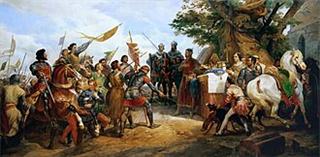
The Capetian dukes were great feudal lords who led their vassals in the wars of the French kings and on crusade. Hugh III commanded the French contingent of the Third Crusade after Philip II returned home in 1191 and died at Acre in 1192, Odo III fought for Philip II at the Battle of Bouvines in 1214, and Hugh IV joined the crusade of Louis IX to Egypt in 1248–1250. Military power grew dramatically under the Valois dukes, who could draw on the wealth of Flanders and the Low Countries as well as the duchy. In 1396 the future John the Fearless led the Burgundian contingent of the crusade destroyed by the Ottomans at the Battle of Nicopolis, where he was captured and later ransomed. As duke he crushed the rebellious citizens of Liège at the Battle of Othée in 1408 and fought the Armagnac faction in the French civil war, while Philip the Good’s armies took part in the Hundred Years’ War and repeatedly suppressed revolts in Flemish cities. Charles the Bold created standing companies of ordinance in 1471 and a powerful artillery train, but his army was routed by the Swiss Confederates at the Battle of Grandson and the Battle of Morat in 1476, and he was killed at the Battle of Nancy on 5 January 1477.
Governance & Law
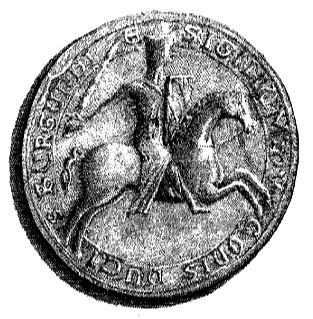
Under the Capetian dukes the duchy was governed much like the royal domain in miniature. The duke ruled with a council of barons and household officers, drew revenues from his domains, tolls and justice, and administered his lands through provosts and, from the thirteenth century, through bailiffs based in districts such as Dijon, Auxois, Chalon and the Montagne. The dukes were peers of France and vassals of the king, but they governed their duchy with wide autonomy, and Hugh IV extended it in 1237 by acquiring the county of Chalon. Odo IV’s marriage to Joan of France brought the Free County of Burgundy and Artois to the ducal house in 1330, uniting the two Burgundies for a time. The Valois dukes built a far more elaborate administration with Dijon as one of their main centres. Philip the Bold set up a Chambre des comptes at Dijon in 1386 to audit the accounts of the two Burgundies, the ducal Parlement at Beaune served as the duchy’s highest court, and the Estates of Burgundy, representing clergy, nobles and towns, voted taxes. Chancellors such as Nicolas Rolin, who served Philip the Good as chancellor for more than thirty years, directed a government that stretched from Burgundy to Holland, while the ducal palace at Dijon remained the symbolic seat of the dynasty.
Global & Regional Impact

The duchy’s influence ran through the Church, the arts and dynastic politics. Cîteaux and its daughter houses spread the Cistercian order across Europe, with some five hundred abbeys by 1200, carrying new methods of farming, water management and building. Henry of Burgundy, a grandson of Duke Robert I, became count of Portugal, and his son Afonso Henriques became the first King of Portugal, founding the dynasty known as the Portuguese House of Burgundy, which ruled until 1383. Under the Valois dukes Burgundy became the base of a power that rivalled the French crown. Philip the Bold founded the Charterhouse of Champmol outside Dijon in 1383 as the dynasty’s burial place, where the sculptor Claus Sluter created the Well of Moses and worked on the duke’s tomb, works that transformed northern European sculpture. Philip the Good founded the Order of the Golden Fleece in 1430, and the court’s ceremony, music and patronage of painters such as Jan van Eyck set standards of princely display across Europe. His chancellor Rolin founded the Hospices de Beaune in 1443 and commissioned Rogier van der Weyden’s altarpiece of the Last Judgement for it. Through the marriage of Mary of Burgundy to Maximilian of Austria, the Burgundian inheritance and the claim to the duchy passed to the Habsburgs.
Decline & Fall

The Capetian line ended when the young Duke Philip of Rouvres died of plague in 1361. King John II of France took the duchy as nearest heir and in 1363 granted it to his youngest son, Philip the Bold, as an appanage. Philip’s marriage in 1369 to Margaret of Male, heiress of Flanders, Artois and the Free County of Burgundy, made the duchy the core of a much larger Burgundian State, which his successors John the Fearless, Philip the Good and Charles the Bold extended across the Low Countries. Their ambitions drew them into conflict with the French crown. John the Fearless was murdered on the bridge at Montereau in 1419 by followers of the Dauphin, and Philip the Good allied with England until the Treaty of Arras in 1435, when he gained the counties of Mâcon and Auxerre. Charles the Bold sought to link his lands and win a royal crown, but his wars against the Swiss Confederates and Lorraine ended with his death at the Battle of Nancy in January 1477. Louis XI of France immediately occupied the duchy, claiming that the appanage had reverted to the crown in the absence of a male heir. Mary of Burgundy and the Habsburgs kept most of the Low Countries, but the duchy remained French; the Treaty of Madrid of 1526, which ceded it to Charles V, was never carried out.
The Duchy of Burgundy was the principality around Dijon that nurtured the Cistercian order and Europe’s most celebrated vineyards, and under its Valois dukes it became the base of a Burgundian power whose wealth, court culture and rivalry with France shaped late medieval Europe until Charles the Bold’s death at Nancy in 1477.
References
- Bouchard, C.B. (1987) Sword, Miter, and Cloister: Nobility and the Church in Burgundy, 980–1198. Ithaca: Cornell University Press.
- Richard, J. (1954) Les ducs de Bourgogne et la formation du duché du XIe au XIVe siècle. Paris: Les Belles Lettres.
- Vaughan, R. (1962) Philip the Bold: The Formation of the Burgundian State. London: Longmans.
- Vaughan, R. (1970) Philip the Good: The Apogee of Burgundy. London: Longman.
- Vaughan, R. (1973) Charles the Bold: The Last Valois Duke of Burgundy. London: Longman.
Connections
Open the full connections map →