Europe
Crimean Khanate
At a glance
- A successor state of the Golden Horde founded c. 1441 by Haci I Giray, a descendant of Genghis Khan.
- From 1475 an Ottoman vassal and ally, its cavalry raids on Poland-Lithuania and Muscovy fed the slave market of Caffa.
- Russian victories made it a nominally independent protectorate in 1774, and Catherine II annexed it in 1783.
Rise & Fall
- c. 1441Haci I Giray establishes an independent khanate in the Crimea
- 1475Ottomans conquer Caffa; Mengli I Giray later accepts Ottoman suzerainty
- 1502Mengli Giray destroys the Great Horde
- 1571Devlet I Giray burns Moscow
- 1648Islam III Giray allies with Bohdan Khmelnytsky against Poland-Lithuania
- 1736A Russian army under Münnich burns Bakhchysarai
- 1774Treaty of Kuchuk Kainarji ends Ottoman suzerainty
- 1783Catherine II annexes the Crimea to the Russian Empire
Foundation

The Crimean Khanate was one of the successor states of the Golden Horde, the western part of the Mongol Empire, which broke apart in the fifteenth century into rival khanates. Its founder, Haci I Giray, a descendant of Genghis Khan through Jochi’s son Tuqa-Timur, had spent years in exile in the Grand Duchy of Lithuania. With Lithuanian support and the backing of the leading Crimean Tatar clans, he established an independent khanate in the Crimean peninsula and the neighbouring steppe around 1441; the exact date is uncertain, and some historians prefer 1443 or 1449. His first residence was at Qırq Yer, the cliff fortress later called Chufut-Kale, near the later capital of Bakhchysarai. The southern coast of the peninsula was then held by the Genoese colony of Caffa and the Orthodox principality of Theodoro. After Haci Giray’s death in 1466 his sons fought for the throne. In 1475 an Ottoman fleet under Gedik Ahmed Pasha conquered Caffa and Theodoro, and Mengli I Giray, restored to the throne with Ottoman support in 1478, accepted the suzerainty of the sultan. In 1502 Mengli Giray destroyed the Great Horde, the last remnant of the Golden Horde, making Crimea the strongest Tatar power of the western steppe.
Socioeconomy
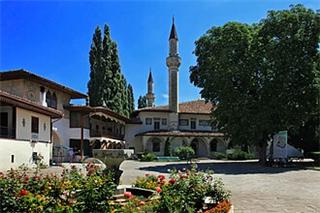
The khanate combined the pastoral life of the Nogai steppe north of the isthmus of Perekop with settled agriculture, orchards and vineyards in the valleys of the peninsula. The Crimean Tatars were Sunni Muslims of the Hanafi school, and their Turkic language became the language of administration and literature; Crimean Tatar society absorbed Kipchak, Greek, Gothic and Italian elements of the peninsula’s older population. Christian Greeks and Armenians and the Karaite Jews of Chufut-Kale lived under the khans’ rule. Salt from the lakes near Perekop, livestock, hides and horses were exported, but the most profitable trade was in captives. Raids into Poland-Lithuania and Muscovy seized men, women and children who were sold through the slave market of Caffa, under direct Ottoman rule, to buyers across the Ottoman Empire and the Mediterranean. Historians’ estimates of the number of people taken between the late fifteenth and late seventeenth centuries run to well over a million, although exact figures are uncertain. Regular ‘gifts’, in effect tribute, paid by Muscovy and Poland-Lithuania to the khan added to court revenue. The capital Bakhchysarai, founded around 1532, grew around the Khan’s Palace, mosques, baths and the Zincirli Medrese built by Mengli Giray in 1500.
Military

The khanate’s strength lay in its light cavalry, mounted archers who could cover great distances on hardy steppe horses and campaign without heavy baggage. Large raids, often launched in winter when rivers were frozen, followed steppe routes such as the Muravsky Trail into Muscovy or crossed into Podolia and Volhynia. Muscovy responded by building fortified lines, the Great Abatis Belt and later the Belgorod Line, while the Zaporozhian Cossacks grew partly as a frontier society facing the Tatars. In 1521 Mehmed I Giray reached the outskirts of Moscow, and in 1571 Devlet I Giray burned the city, though the next year Russian forces defeated him at the Battle of Molodi. Crimean contingents also fought in Ottoman wars in Hungary, the Caucasus and Persia, and joined the Ottoman army at the Siege of Vienna in 1683. The khans pursued their own policy in Eastern Europe: Islam III Giray allied with the Cossack hetman Bohdan Khmelnytsky in 1648, contributing to victories at Zhovti Vody and Korsun before abandoning him at Berestechko in 1651, and Mehmed IV Giray helped Hetman Ivan Vyhovsky defeat a Russian army at the Battle of Konotop in 1659. The fortress of Or Qapı at Perekop guarded the peninsula’s only land approach.
Governance & Law
The khan, always a member of the Giray dynasty, ruled from Bakhchysarai with a divan, or council, but shared power with the beys of the great clans, above all the Şirin, Barın, Arğın and Qıpçaq, whose leaders, the karachi beys, controlled their own lands and warriors and could make or unmake khans. The heir designate held the office of kalgay, and a second prince the office of nureddin, each with his own court and revenues. Islamic law was administered by qadis, and the clergy, headed by a mufti, had a voice in politics. The relationship with the Ottoman Empire defined the state. After 1475 the sultans ruled the southern coast, with Caffa, as the province of Kefe, and from the later sixteenth century they appointed and deposed khans, often choosing among Giray princes who lived on Ottoman estates. Khans who defied Istanbul could be removed, and some ruled several separate times. Yet the khans kept the attributes of sovereignty: they minted coins, had their names read in Friday prayers, conducted diplomacy with Poland-Lithuania and Muscovy and received envoys. Their Chinggisid descent gave them a prestige that even the Ottoman sultans respected, and the Girays were sometimes regarded as potential heirs should the house of Osman die out.
Global & Regional Impact

For three centuries the Crimean Khanate was a major power of Eastern Europe, and its raids shaped the societies of its northern neighbours. The need to defend against Tatar cavalry drove Muscovy’s construction of fortified frontier lines and its colonisation of the southern steppe, influenced the growth of the Cossack hosts, and drained population and wealth from Ukraine, Podolia and southern Russia. Muscovy’s payments to the khan continued until the Treaty of Constantinople in 1700. As the Ottomans’ northern ally, the khanate secured the Black Sea as an Ottoman lake for two centuries and supplied cavalry for Ottoman campaigns. It also preserved the political traditions of the Golden Horde: its diplomatic documents, the yarlıks issued by the khans, are a major source for the history of Eastern Europe. Culturally, the Khan’s Palace at Bakhchysarai, with its Fountain of Tears, inspired Alexander Pushkin’s poem The Fountain of Bakhchisaray (1824), and khans such as Gazi II Giray were noted poets. The khanate is the historical homeland state of the Crimean Tatars, whose national identity, language and memory of statehood remain tied to it, especially after their mass deportation by Stalin’s government in 1944 and their return from the late 1980s.
Decline & Fall

The balance of power on the steppe shifted against the khanate from the late seventeenth century. Russia’s capture of Azov in 1696, though reversed in 1711 after Peter the Great was encircled on the Pruth, showed that Russian armies could reach the Black Sea. In 1736, during the Russo-Turkish War, a Russian army under Burkhard Christoph von Münnich stormed Perekop and burned Bakhchysarai, and slave raiding declined as Russian and Polish frontiers advanced. In the Russo-Turkish War of 1768–1774 Russian forces occupied the peninsula in 1771. The Treaty of Kuchuk Kainarji in 1774 ended Ottoman suzerainty and declared the khanate independent, though the Ottoman sultan kept a religious authority as caliph. In practice the khanate became a Russian protectorate. Russia installed Şahin Giray as khan in 1777; his attempts at centralising, European-style reforms provoked revolts that Russian troops suppressed. Advised by Grigory Potemkin, Catherine II proclaimed the annexation of Crimea to the Russian Empire on 8 April 1783, and Şahin Giray abdicated. Large numbers of Crimean Tatars emigrated to the Ottoman Empire in the following decades, and Russian and other settlers were brought in. The peninsula later became part of Soviet Ukraine and independent Ukraine; its status has been contested since Russia’s annexation in 2014.
The Crimean Khanate, last great successor of the Golden Horde, was for three centuries the Ottoman Empire’s northern ally and a formidable steppe power whose cavalry raids and slave trade shaped the frontiers of Poland-Lithuania, Muscovy and Ukraine, and it remains the historical state of the Crimean Tatar people.
References
- Fisher, A.W. (1978) The Crimean Tatars. Stanford: Hoover Institution Press.
- Fisher, A.W. (1970) The Russian Annexation of the Crimea, 1772–1783. Cambridge: Cambridge University Press.
- Kołodziejczyk, D. (2011) The Crimean Khanate and Poland-Lithuania: International Diplomacy on the European Periphery (15th–18th Century). Leiden: Brill.
- Khodarkovsky, M. (2002) Russia’s Steppe Frontier: The Making of a Colonial Empire, 1500–1800. Bloomington: Indiana University Press.
- Davies, B.L. (2007) Warfare, State and Society on the Black Sea Steppe, 1500–1700. London: Routledge.
Connections
Open the full connections map →